A Rare Show of Unity: All 28 Chief Ministers Attend NITI Aayog Meeting Chaired by PM Modi
By ZOLUSE
•
Friday, June 12, 2026
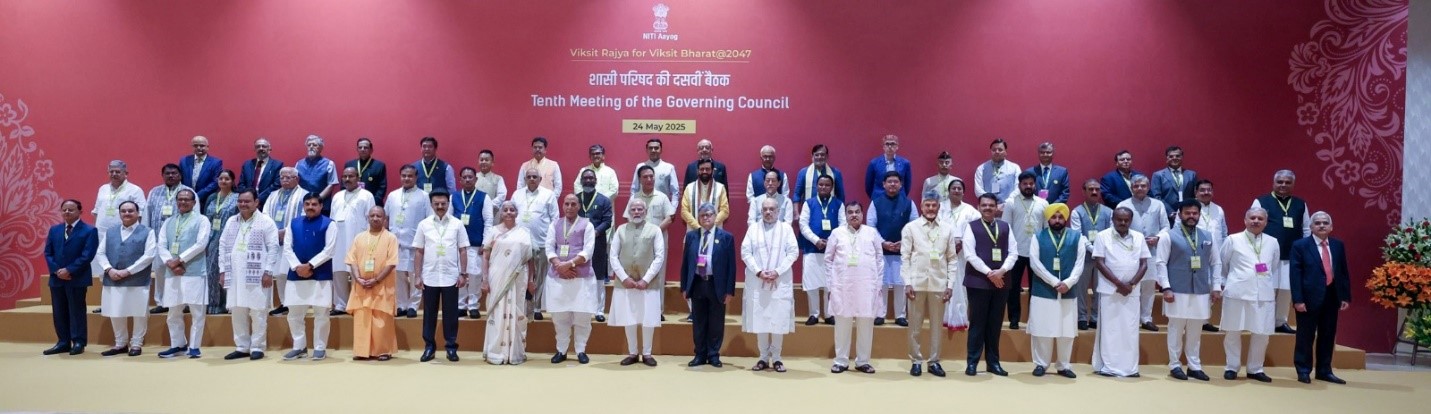
New Delhi: In a rare and politically significant development, all 28 Chief Ministers of India’s states participated in the NITI Aayog Governing Council meeting chaired by Prime Minister Narendra Modi, marking one of the few occasions in recent years when every state government, irrespective of political affiliation, was represented at the national policy forum.
The full attendance is being viewed as a major endorsement of cooperative federalism and comes at a time when relations between the Centre and several opposition-ruled states have often been marked by political disagreements over issues ranging from fiscal transfers and welfare schemes to governance priorities and administrative powers.
The Governing Council of NITI Aayog is India’s highest policy-making platform involving both the Union government and state governments. It serves as a forum where Chief Ministers, Union Ministers, and policymakers discuss developmental challenges, economic priorities, infrastructure needs, social welfare initiatives, and long-term national objectives. The presence of all 28 Chief Ministers transformed the latest meeting into one of the most representative gatherings of political leadership in the country.
Prime Minister Modi, while addressing the council, emphasized the importance of “Team India” and stressed that the nation’s development goals can only be achieved through collaboration between the Centre and the states. He reiterated that India can become a developed nation by 2047 only if every state participates actively in the growth process and contributes according to its strengths and capabilities.
The meeting reportedly focused on a wide range of issues including economic growth, agricultural modernization, employment generation, urban development, water security, healthcare expansion, education reforms, and technological innovation. Special attention was also given to state-specific development strategies aimed at reducing regional disparities and accelerating investment-led growth.
What makes the gathering particularly noteworthy is the participation of Chief Ministers from parties that have often been vocal critics of the central government. In previous years, some NITI Aayog meetings witnessed boycotts or partial attendance by opposition leaders citing political disagreements. This time, however, the presence of every Chief Minister created an atmosphere that many observers described as unusually inclusive.
Political analysts view the development as an indication that states increasingly recognize the importance of institutional dialogue despite political differences. With India aiming to become the world’s third-largest economy and pursuing ambitious infrastructure, manufacturing, and social development goals, cooperation between New Delhi and state capitals is becoming more important than ever.
The meeting also highlighted the growing role of states in India’s economic transformation. Over the past decade, state governments have emerged as major drivers of investment, industrial growth, infrastructure expansion, and welfare implementation. Many of India’s most successful policy experiments have originated at the state level before being adopted nationally.
Several Chief Ministers reportedly used the platform to raise concerns regarding taxation, central grants, disaster management funding, agricultural support mechanisms, and infrastructure financing. Others highlighted successful governance models and sought greater collaboration with the Centre in sectors such as renewable energy, digital governance, tourism, and skill development.
For the Modi government, the full attendance carries symbolic as well as political significance. It reinforces the Prime Minister’s long-standing emphasis on cooperative and competitive federalism, where states are encouraged to compete on development indicators while working together toward national objectives.
The gathering also comes at a crucial moment for India’s economy. With global geopolitical tensions, supply chain disruptions, climate-related challenges, and technological transformations reshaping the world economy, policymakers believe stronger Centre-state coordination will be essential for sustaining growth and achieving long-term development goals.
Beyond policy discussions, the meeting offered a rare visual of India’s diverse political leadership sitting around a common table despite sharp electoral and ideological rivalries. In a political environment often characterized by confrontation, the image of all 28 Chief Ministers participating in a national development forum carried its own significance.
Observers note that while disagreements between the Centre and states will inevitably continue, forums such as NITI Aayog provide an institutional mechanism for dialogue and consensus-building. The ability to discuss differences within a structured framework is considered one of the strengths of India’s federal system.
Whether the full attendance translates into greater policy coordination remains to be seen. However, the meeting has already succeeded in delivering a powerful message: that despite intense political competition, India’s states and the Union government remain capable of coming together when discussing the country’s future.
In an era of increasingly polarized politics, the sight of every Chief Minister joining a common platform may prove to be as significant as the policy decisions themselves. For one day at least, India’s federal structure displayed not division, but unity—a reminder that national development ultimately requires cooperation across political boundaries.