From Coal to Chemicals: PM Modi to Launch India’s First Commercial-Scale Coal-to-Ammonium Nitrate Project in Odisha
By ZPLUSE STAFF
•
Saturday, June 20, 2026
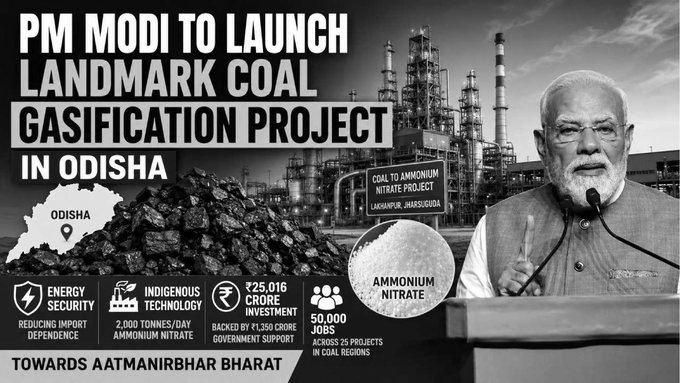
Bhubaneswar: In a landmark step towards industrial self-reliance and energy security, Prime Minister Narendra Modi is set to lay the foundation stone of India’s first commercial-scale coal-to-ammonium nitrate project at Lakhanpur in Odisha’s Jharsuguda district. With an investment of approximately ₹25,016 crore, the project represents one of the most ambitious coal gasification initiatives undertaken in the country and is expected to transform how India utilizes its vast domestic coal reserves.
The facility is being developed by Bharat Coal Gasification and Chemicals Limited (BCGCL), a joint venture between Bharat Heavy Electricals Limited and Coal India Limited. Once operational, it will produce 2,000 tonnes of ammonium nitrate per day using indigenously developed coal gasification technology, making it the first commercial-scale deployment of this technology in India.
At the heart of the project lies coal gasification, a process that converts coal into synthesis gas, or syngas. Unlike conventional coal combustion, gasification transforms coal into a versatile chemical feedstock that can be used to manufacture products such as ammonium nitrate, methanol, urea, synthetic natural gas, and other industrial chemicals. The government views this technology as a crucial component of India’s strategy to reduce dependence on imported raw materials while extracting greater value from domestic coal resources.
The importance of ammonium nitrate extends far beyond the chemical industry. It is a critical ingredient in industrial explosives widely used in mining, infrastructure development, road construction, and large-scale engineering projects. India currently relies significantly on imports to meet a portion of its ammonium nitrate requirements. By establishing domestic production at commercial scale, the project aims to reduce import dependence, improve supply security, and strengthen the country’s industrial ecosystem.
The initiative also aligns with the government’s broader vision of “Atmanirbhar Bharat” and its push for import substitution. Coal gasification has emerged as a strategic priority because it allows India to leverage its abundant coal reserves while reducing exposure to volatile global commodity markets. Policymakers believe that converting coal into high-value chemicals and industrial feedstocks can generate greater economic returns than simply burning it for power generation.
A particularly significant aspect of the Lakhanpur project is its reliance on indigenous technology. The gasification process will utilize BHEL’s in-house developed Pressurised Fluidised Bed Gasification technology, marking its first commercial-scale application. The project is therefore being viewed not only as an industrial investment but also as a demonstration of India’s growing technological capabilities in advanced energy and chemical engineering.
The project is expected to provide a major boost to Odisha’s industrial landscape. Jharsuguda, already a key mining and industrial hub, is likely to witness increased economic activity, infrastructure development, and employment opportunities as construction and operations progress. The facility could also encourage the growth of downstream chemical industries and ancillary businesses in the region.
Strategically, the project forms part of India’s long-term goal of expanding coal gasification capacity and creating a domestic coal-chemicals industry. The government has identified coal gasification as a priority sector capable of enhancing energy security, supporting manufacturing growth, and reducing reliance on imported feedstocks that are essential for several industrial sectors.
The foundation stone ceremony therefore represents much more than the launch of a single industrial plant. It signals a shift in India’s approach to coal from viewing it solely as a fuel for power generation to recognizing it as a valuable raw material for advanced chemical manufacturing. If successful, the Lakhanpur project could become a model for future coal-to-chemical facilities across the country.
As India seeks to balance energy security, industrial growth, and technological self-reliance, the coal-to-ammonium nitrate project in Odisha stands out as a bold experiment in value addition and resource utilization. For policymakers, industry leaders, and energy planners alike, the project represents a significant milestone in the country’s journey toward building a more diversified and self-sufficient industrial economy.