The Baby Bust: Why Elon Musk Is Warning About India’s Falling Birth Rate — And Why It Matters
By ZPLUSE STAFF
•
Tuesday, June 9, 2026
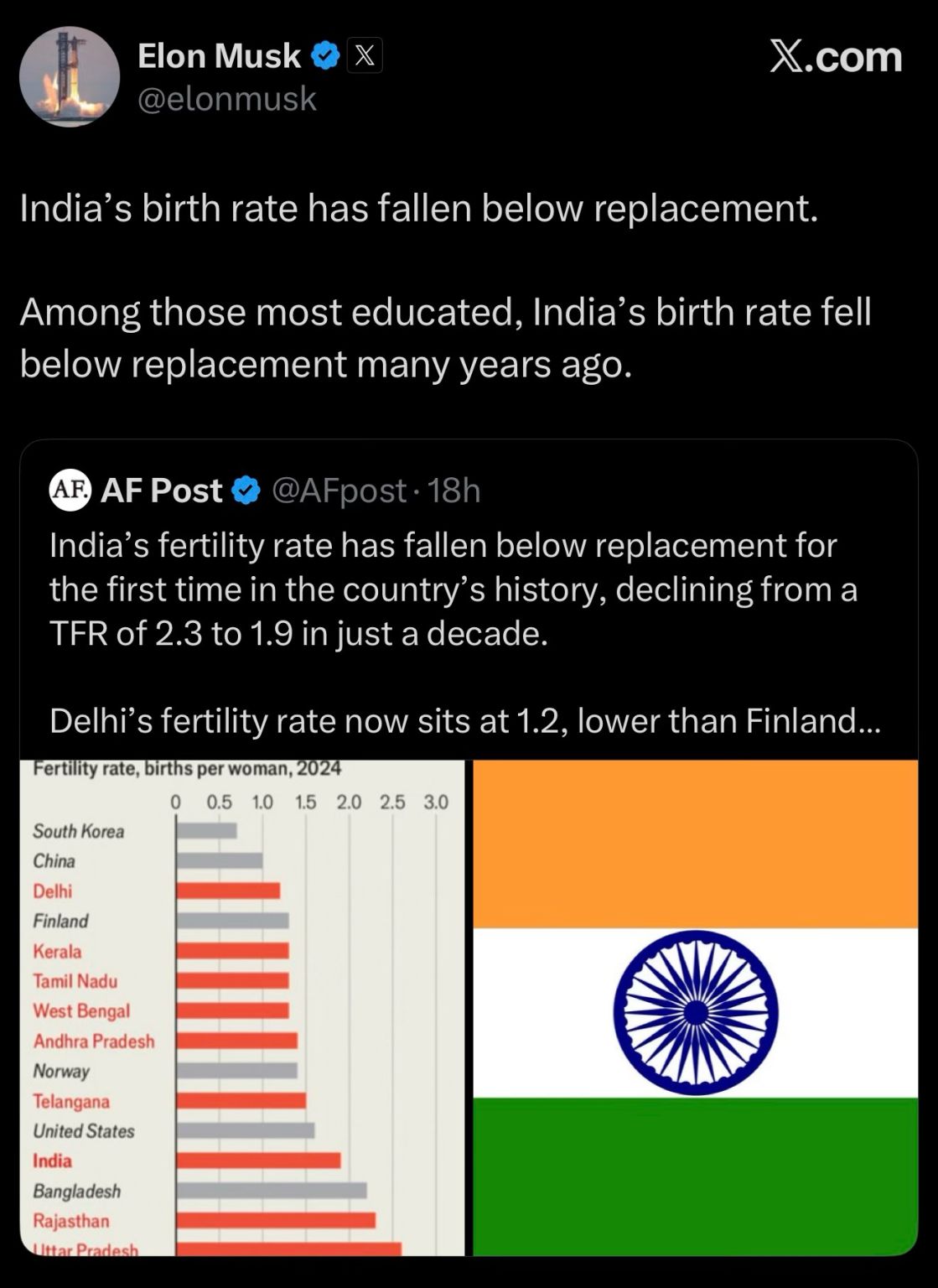
New Delhi: Billionaire entrepreneur Elon Musk has once again sparked a global debate on demographics after highlighting India’s rapidly declining fertility rate, warning that population decline could eventually become a bigger threat to nations than overpopulation. While India recently overtook China to become the world’s most populous country, demographic experts say the country’s population story is undergoing a dramatic transformation that could reshape its economic and social future over the coming decades.
For much of the twentieth century, India was viewed as a country struggling with rapid population growth. Governments focused on family planning, resource management, and controlling demographic expansion. Today, however, the conversation is beginning to shift. India’s fertility rate—the average number of children a woman is expected to have during her lifetime—has fallen sharply and is now below the replacement level required to maintain a stable population over the long term.
Replacement-level fertility is generally considered to be around 2.1 children per woman. India’s fertility rate has fallen to approximately 1.9, meaning that each new generation is becoming smaller than the one before it. While the country’s overall population will continue growing for some time because of demographic momentum, experts believe that India could eventually face many of the same challenges currently confronting countries such as Japan, South Korea, China, and several European nations.
Elon Musk has repeatedly argued that declining fertility is among the greatest long-term risks facing modern societies. According to him, many countries are underestimating the economic and social consequences of shrinking populations. His comments have drawn attention because they come at a time when birth rates are collapsing across much of the developed world, forcing governments to rethink policies related to labor markets, pensions, healthcare, and economic growth.
The decline in India’s fertility rate is being driven by multiple factors. One of the most important reasons is rising education levels, particularly among women. Better educational opportunities often lead to delayed marriages, greater workforce participation, and lower family sizes. As women gain more economic independence and career opportunities, family planning decisions increasingly reflect personal and financial considerations.
Urbanization is another major factor. In rural India, larger families were traditionally viewed as economic assets because children contributed to agricultural and household work. In urban areas, however, raising children is significantly more expensive. Housing costs, education expenses, healthcare requirements, and lifestyle expectations have encouraged many couples to limit family size.
Economic pressures are also influencing fertility decisions. Young Indians today face intense competition in education and employment. Many couples delay marriage and parenthood while focusing on career stability, financial security, and home ownership. The rising cost of living in major cities has further reinforced this trend.
Changing social attitudes have also played a significant role. Smaller families have become increasingly common across social and economic groups. Access to contraception, improved healthcare, greater awareness of family planning, and changing aspirations have all contributed to declining birth rates.
What makes the situation particularly noteworthy is the speed of the decline. India has reached below-replacement fertility levels at a much lower income level than many developed countries. Historically, nations experienced fertility decline after becoming wealthy. India is encountering this transition while still working to achieve higher levels of economic development and per capita income.
The demographic picture, however, remains uneven across the country. Several southern states such as Kerala, Tamil Nadu, Karnataka, and Andhra Pradesh have fertility rates significantly below replacement level and are already witnessing early signs of population aging. Northern states including Bihar and Uttar Pradesh continue to have relatively higher fertility rates, although they too have experienced substantial declines over the past two decades.
The consequences of declining fertility are complex. In the short term, India still enjoys what economists call a “demographic dividend”—a large working-age population capable of driving economic growth. This youthful workforce has been one of India’s greatest economic advantages and remains a key reason why global investors are optimistic about the country’s future.
The challenge emerges over the longer term.
As fertility rates remain low, the proportion of elderly citizens gradually increases while the working-age population begins to shrink. This creates pressure on pension systems, healthcare infrastructure, social welfare programs, and labor markets. Countries such as Japan and South Korea are already struggling with these realities, facing labor shortages and rapidly aging populations.
China’s experience serves as a particularly relevant example. After decades of strict population control policies, China is now confronting one of the fastest demographic declines in modern history. Falling birth rates, an aging workforce, and declining population growth have become major concerns for Chinese policymakers.
Some Indian states have already begun responding to the trend. Governments in Andhra Pradesh and several other regions have started discussing incentives aimed at encouraging larger families. Policymakers are increasingly recognizing that declining fertility may become an important long-term economic challenge.
However, experts caution against alarmism. India’s demographic transition remains very different from that of many developed nations. The country still has a large young population, and its workforce will continue expanding for years. The immediate challenge is not population decline but creating enough jobs, skills, and opportunities to fully utilize the demographic dividend currently available.
The debate triggered by Elon Musk’s comments ultimately highlights a broader global shift. For decades, policymakers worried about excessive population growth. Today, many countries are confronting the opposite problem: too few births, shrinking workforces, and rapidly aging societies.
India now stands at a unique demographic crossroads. It remains the world’s most populous nation and one of its youngest major economies. Yet beneath those headlines lies a quieter transformation that could shape the country’s future as profoundly as any economic or technological change.
Whether India’s falling fertility rate becomes a crisis or an opportunity will depend largely on how policymakers respond. If the country can harness its current demographic dividend while preparing for future aging trends, it may avoid the difficulties now confronting several advanced economies.
But one thing is increasingly clear: the debate over India’s population is no longer about how many people the country has. It is about how many it will have in the decades to come and what that means for the future of the world’s largest democracy.